


If you are someone who was offered a great role with a good paycheck, and a promotion is on its way, despite having all the things that make a career look successful, why does everything still feel wrong?
You may feel a kind of dissatisfaction like “I am doing everything right, so why do I still feel unhappy?” You’re not alone. A career can look successful from the outside while making you feel restless, disconnected, or unsure about what you actually want.
Before You Change Your Career, Find the Real Problem
When a career stops feeling right, the first instinct can be to make a big move. Finding another job, changing industries, or quitting and starting something completely different.
But what if you change careers and discover that the same problem follows you? Before deciding what to change, it helps to understand what is actually missing.
| What you really need | What happens if you change jobs without addressing it |
| Autonomy | The new role is just as restrictive, so you still feel frustrated. |
| Challenge | The new job has the same repetitive responsibilities, so you feel just as stuck. |
| Balance | The higher-paying role demands even more of your time, so the problem remains. |
Start by asking yourself:
- What parts of my current work give me energy?
- What parts consistently drain me?
- Do I want more freedom, challenge, stability, meaning, expertise, leadership, or balance?
- Am I unhappy with my career, or with the way I am currently working?
- If salary and status were removed from the equation, what would I still want from work?
- Have I been following my own definition of success, or someone else’s?
You don’t need to have all the answers immediately. You need a better starting point.
What If You Could Identify What Actually Drives Your Career Choices?
This is exactly where Career Anchors become useful. Originally developed by organizational psychologist Dr. Edgar Schein, the Career Anchor framework looks at the underlying work factors that influence people’s career choices and satisfaction.
The framework includes nine Career Anchors:
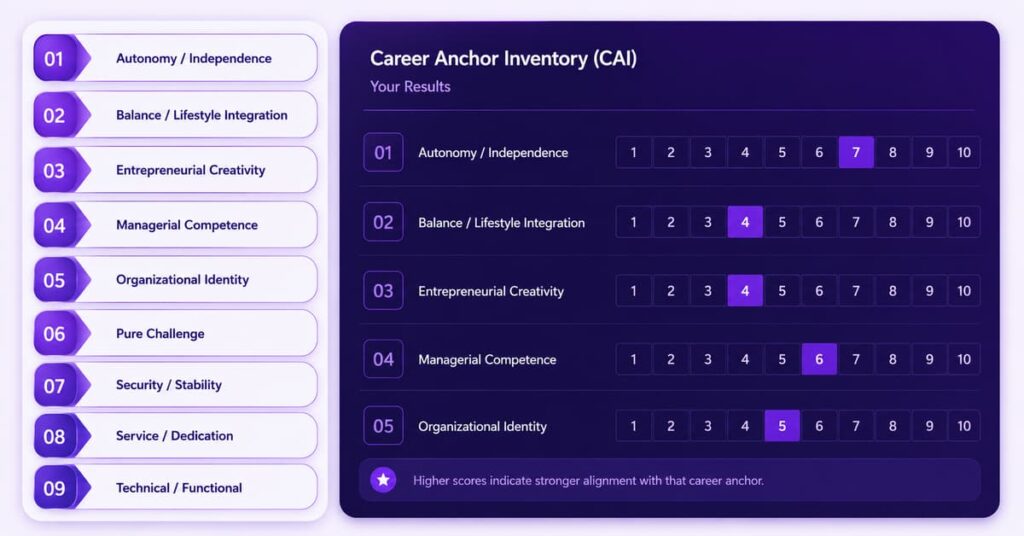
- Autonomy/Independence
- Balance/Lifestyle Integration
- Entrepreneurial Creativity
- Managerial
- Organizational Identity
- Pure Challenge
- Security/Stability
- Service/Dedication
- Technical/Functional
Think of these as different answers to the question:
What do I need from work, so that my career feels like it fits me?
- Someone who values Autonomy/Independence may feel frustrated when they have to get approval for every decision.
- People who value Technical/Functional expertise may enjoy deepening their skills in their field rather than moving into management just because it is seen as the next step.
- Someone who values work-life balance may not see a bigger title as progress if it means constantly working and living in hustle mode.
- Entrepreneurial Creativity can show up as a strong pull toward building something of your own rather than following a conventional career path.
And suddenly, “I don’t like my work anymore” becomes a much more specific question:
Meet the Career Anchor Inventory
The Career Anchor Inventory (CAI) is designed to help you explore exactly that. It contains 36 statements, with four questions representing each of the nine Career Anchors. You respond using a 6-point response scale, and the assessment takes approximately 15–20 minutes.
The report identifies your top three Career Anchors and provides descriptions of the motivations, preferred work environments, and potential career choices associated with them.
But the real value isn’t simply seeing three labels on a report. It’s what you do with the insight.
Imagine your results show Autonomy/Independence among your strongest anchors.
Instead of immediately resigning, you could ask:
- Can I take ownership of larger projects?
- Can I move into a role with more decision-making freedom?
- Would an internal move solve some of the problem?
- Would working with a coach help me explore this further?
Or suppose Pure Challenge is prominent, but your current role has become repetitive. You now have something specific to investigate.
Maybe you need a more challenging project, maybe you need a different role within the same organisation or developing a new skill could makes things better. Or perhaps, after exploring those options, you realise the career path itself genuinely isn’t a good fit.
That’s a much safer decision to make when you have actually investigated the problem first.
Don't Treat the Result as a Verdict
A Career Anchor assessment shouldn’t be used as: “My result says X, therefore I need to quit my job.”
It is better used as a starting point for reflection.
Your results can give you a clearer language for discussing career preferences and can support self-awareness, career planning, coaching, career transitions, and developmental conversations.
You can take the results to a coach, discuss it with a mentor or you can compare them with your current role and ask what can realistically be changed. Then give yourself time.
Work on the bottleneck before you abandon everything you’ve built.
Conclusion
A career that looks good on paper doesn’t always feel right. Career Anchor Inventory can help you understand what is actually driving that feeling, whether it’s autonomy, challenge, stability, entrepreneurship, expertise, or something else.
Once you know the gap, you can decide what to explore, change, or work on before making a major career move. Sometimes, clarity is the first step toward the right career decision.
Frequently Asked Questions
Does Career Anchor Inventory tell me which career I should choose?
No. It helps identify your strongest career drivers. The results can support reflection and career planning rather than prescribe one career.
How long does the assessment take?
Approximately 15–20 minutes, with 36 statements.
Can I have more than one Career Anchor?
Yes. The report identifies your top three Career Anchors.
What if I already have a successful career?
That’s exactly when the exercise can be useful. You can explore whether your current role actually aligns with the factors you value most.
Should I quit my job if my results don’t match my current role?
Not necessarily. Use the results to identify what may be missing, explore what can be changed, and consider your options before making a major decision.