

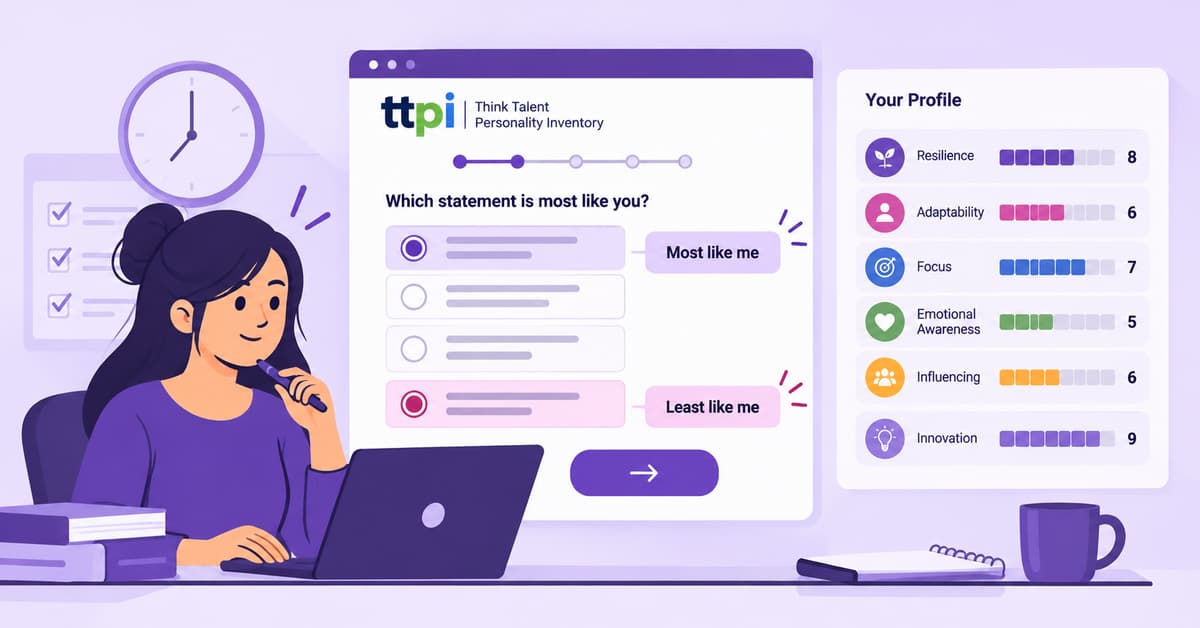
You’re partway through a personality assessment. Four statements appear on the screen, and three of them sound like you. But the Think Talent Personality Inventory (TTPI) still wants you to pick one that is most like you, and one that is least like you.
Your first thought might be “Why can’t I just rate each one?”
That’s a fair question. And once you understand why, it helps you make sense of how TTPI works and what your results mean.
TTPI uses a forced-choice format by design. Instead of rating each statement on its own, you choose what is most and least like you. Those choices build a picture of your workplace personality.
What does the TTPI forced-choice format actually look like?
Let’s make it simple.
TTPI presents 120 statements divided into 30 sets of four. In every set, you choose:
- One statement that is most true for you
- One statement that is least true for you
You make both choices, even when more than one statement feels like a good fit.
So instead of asking: “How much do I agree with this statement?”
TTPI asks you to think:
“Out of these options, which one sounds most like me, and which one sounds least like me?”
That small difference is what makes the TTPI assessment a forced-choice personality assessment.
Why doesn't TTPI simply ask you to rate every statement?
Because usually, while taking an assessment, people relate to several statements at the same time.
You might be someone who is organised, curious, focused, and also comfortable with change. If you rated each quality separately, you could end up giving several statements a high rating. This is where forced-choice comes in. It makes you compare the statements.
For example, TTPI’s statements can describe different ends of a behavioural tendency. On the Focused trait, one side describes someone who jumps between tasks and gives attention to several issues, while the other describes someone who stays deeply focused on one task and shuts out distractions.
You are not simply saying, “Yes, I can focus.” You are choosing which description is more characteristic of you. When you do this across the assessment, TTPI can build a broader picture of your behavioural tendencies at work.
What does TTPI actually tell you about yourself?
This is where the questionnaire becomes more than just a set of questions.
TTPI looks at 20 workplace personality traits across six clusters: Drive for Results, Process Orientation, Innovation Orientation, Resilience, Emotional Awareness, and Influencing Orientation.
Your responses are converted into STEN scores on a 1–10 scale. The report presents these scores visually, where 5 and 6 represent the average range, while scores further to either side show more pronounced behavioural tendencies.
So you don’t finish the assessment with a pile of answers and have to figure everything out yourself. Your responses are brought together into a structured personality profile.
What do you get from the TTPI report?
This is the more important question. A score by itself isn’t very useful if you don’t know what to do with it.
TTPI’s report goes a step further. Its cluster-wise interpretation explains what your scores could mean in terms of Potential Enablers, Potential Derailers, and Questions for Reflection.
For example, a cluster may highlight a strength that can work in your favour, while also showing where that same tendency could create challenges. This gives you something to talk about and reflect on.
Instead of just saying: “My score is 7.”
The conversation becomes:
- “What does this tendency look like in my work?”
- “When does it help me?”
- “When could it get in my way?”
That is where personality assessment becomes useful for development.
Where can you use TTPI?
TTPI is not limited to just one type of conversation. Its insights can be useful for discussions around leadership, career development, self-awareness, competencies, and workplace behaviour.
For coaches, it gives more context to work with.
For individuals, it can help them understand patterns in how they approach work, make decisions, build relationships, handle change, and work towards results.
For organisations, it provides a structured way to bring personality insights into talent and development conversations.
TTPI can also be used through different report formats. For example, the Focused Profile presents selected traits and behaviours for a specific role or context. This makes it possible to tailor the report to a particular need.
How long does the TTPI assessment take?
The TTPI assessment takes around 15–20 minutes to complete and is available in more than 12 Indian languages, as well as multiple global languages.
So, although the forced-choice format asks you to think carefully about your answers, it does not make the assessment a long exercise.
One thing to remember about TTPI results
TTPI is a self-description instrument. The report explains that trait scores are based on self-reported personality data and describe innate personality characteristics. However, acquired behaviour may sometimes be different from how a person perceives their personality.
That is why the report encourages discussion instead of treating a score as a final verdict about a person. The real value lies in using the profile to ask better questions.
TTPI measures workplace personality preferences and behavioural tendencies, not intelligence, skills or job performance. It should never be the only basis for a hiring or promotion decision.
Conclusion
So, why does TTPI use forced-choice questions? Because the goal is not simply to find out whether you agree with a statement.
It is about understanding which behavioural tendencies are more characteristic of you compared with your other tendencies. These choices help TTPI build a broader picture of your behavioural tendencies at work.
So, the next time TTPI asks you to choose between statements that all sound like you, remember that you are not being asked to find a “right” or “wrong” answer.
That choice is part of how TTPI gets to the bigger picture.
Explore how TTPI on Elemetrik can give you and the people you coach a clearer picture of how you work.
Frequently Asked Questions
What is a forced-choice personality assessment?
It asks you to choose between statements rather than rate every statement independently. TTPI uses this format by asking you to select one most-like and one least-like statement in each set.
How many questions are in TTPI?
TTPI has 120 statements arranged into 30 sets of four.
What does TTPI measure?
TTPI covers 20 workplace personality traits across six personality clusters.
What are TTPI STEN scores?
TTPI presents results on a 1–10 STEN scale, showing where behavioural tendencies are more or less pronounced.
Is TTPI useful for coaching and development?
Yes. The report includes potential enablers, potential derailers and reflection questions that can give coaches and leaders a starting point for deeper development conversations.