

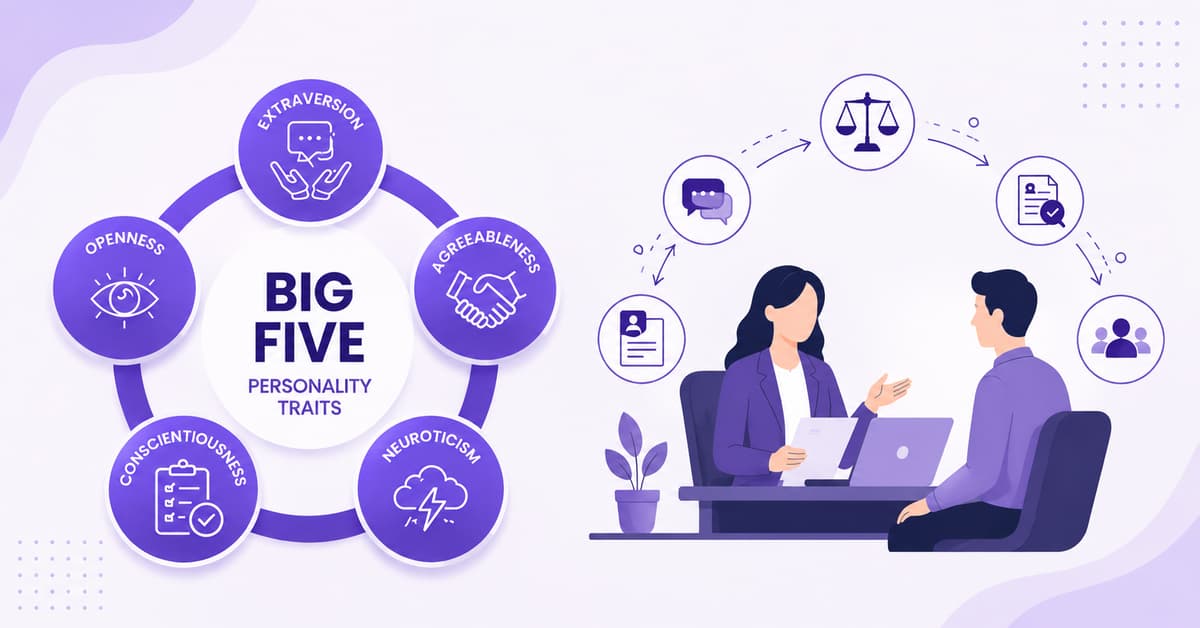
Many of us have heard of the Ocean Big Five personality model. It is the gold standard of psychometrics frameworks that is used widely for understanding personalities better. But when it comes to the workplace, a lot of people misunderstand what it tells.
Some believe it shows who will get successful in a role, while others believe it labels people into fixed personality types. In reality, it does neither of those.
The OCEAN Big Five is a framework that helps us understand people in the workplace, such as, how someone naturally tends to think, feel, and behave. These insights help explain how a person is likely to approach their work, interact with others, and handle different situations. The Think Talent Personality Inventory (TTPI) is based on the OCEAN Big Five Personality Framework and uses it to measure workplace personality characteristics that are relevant across hiring, coaching, leadership development, and talent management.
Understanding Workplace Behaviour Beyond Skills
When hiring someone, talent acquisition tends to focus mostly on qualifications, technical skills and experience. These matter, but they don’t really explain why two people with almost the same experience approach work so differently.
One employee likes exploring new ideas, adapting as things change. Another prefers a structured process, following already set rules. One manager takes ownership the moment things get difficult. Another wants to gather more information before deciding anything. Neither approach is right or wrong. They are just different behavioural preferences.
This is where the Ocean Big Five actually becomes useful. It helps organisations understand these behavioural tendencies in the workplace, and that can shape better conversations around hiring, coaching, leadership development and team effectiveness.
The Ocean Big Five describes personality across five broad dimensions:
- Openness reflects how people approach new ideas, learning, creativity, and change.
- Conscientiousness is about how people organise their work, stay focused and follow through.
- Extraversion helps explain how people interact with others and where they draw their energy from.
- Agreeableness reflects how individuals build relationships, cooperate with others, and approach teamwork.
- Neuroticism, often talked about in workplace terms through emotional tendencies, explains how people respond to pressure and difficult situations.
These dimensions are not personality types. Every individual demonstrates each of them to different degrees, creating a unique workplace personality profile.
Turning Personality Into Workplace Insights
TTPI builds on the OCEAN Big Five. It turns the five dimensions into 20 workplace personality traits, ones that show how someone is likely to approach their work.
These traits are grouped into clusters. That makes it easier to read in a workplace context, instead of sounding like abstract psychology.
So instead of just knowing someone scores high or low on a broad trait, you get something more useful. You see results like adaptability, dependability, achievement orientation, creativity, focus, empathy, and stress management. Traits that actually tell you how someone works with people and handles their responsibilities.
This is what makes personality insights genuinely useful for everyday people decisions.
What the Ocean Big Five Doesn't Tell You
One of the biggest misconceptions about personality assessments is that they predict success. Or that they can tell you whether someone will actually perform well in a role. That’s not really what they are for.
TTPI measures workplace personality preferences and behavioural tendencies, not intelligence, technical capability or job performance. And it definitely should not be the only thing a hiring or promotion decision is based on.
Instead it works best alongside interviews, experience, actual skills, and just plain professional judgement.
Also, it’s important to remember that there is no “ideal” personality profile out there. Every personality brings its own strengths, and its own areas to work on, depending on the role, the team, and the environment someone’s working in.
Conclusion
The Ocean Big Five doesn’t tell you if someone is a good employee, or a great leader. What it does give you is a structured way to understand how people naturally prefer to work, communicate, collaborate, and handle different situations at work.
When you combine that with interviews, experience, and other assessment methods, organisations end up making more informed decisions. Whether that is for hiring, coaching, leadership development, or talent management.
It’s not replacing human judgement here. It’s just giving you another perspective, one that makes people decisions a little more thoughtful and informed.
Frequently Asked Questions
What is the Big Five personality model?
The Ocean Big Five is a widely used personality framework that describes personality across five broad dimensions: Openness, Conscientiousness, Extraversion, Agreeableness, and Neuroticism. TTPI is based on this model and applies it in a workplace context.
Does the Ocean Big Five predict job performance?
No. Personality assessments measure behavioural tendencies and preferences. They do not predict performance or guarantee success in a specific role.
How is TTPI different from a generic Ocean Big Five assessment?
TTPI extends the Ocean by mapping it to 20 workplace personality traits and presenting insights that are more relevant for organizational decisions such as hiring, coaching, leadership development, and talent management.
Can the Ocean be used for hiring?
Yes, as one source of insight. Personality assessments are most valuable when used alongside interviews, skill assessments, and other evaluation methods rather than as a standalone hiring decision.